Before filing an insurance claim, drivers should consider the effect it can have on their premiums.
Many people file claims for less costly repairs, like cracked or chipped windshields or small dents. We like this article because it serves as a good reminder to think twice before filing a claim for something small that may cost you less, in the long run, to fix yourself.
The same applies to Homeowners insurance as well. (Read this post we recently shared on Facebook for tips on when not to file a home insurance claim.)
Insurance is designed to be used for catastrophic events, not to be used as a "maintenance policy." Often, it's in your best interest to check with your agent before filing a claim, and to actually pay it out of pocket instead of turning the claim in to your carrier. The reality of the matter is, most consumers want to get every penny that they can out of their insurance carrier, because they feel taken advantage of by paying so much into their policy premiums and getting nothing out of it. We can't tell you how many times we hear "that's why I have insurance," from our clients and friends. Still, our job as agents is to educate and have them think twice, and consider the consequences of turning in too many claims, which is not to their advantage and will cost more in increased premiums costs in the long run.
Showing posts with label premiums. Show all posts
Sunday, June 22, 2014
Friday, May 9, 2014
Auto Insurance: Dirty Secrets In Your Policy
Does your policy cover theft? Hail damage?
Falling objects? Your pet?
You pay your
premiums every month, but may be surprised to see what items are NOT covered by
your auto insurance if you don't have a comprehensive policy. Read on for
questions to ask about your coverage, to make sure that saving a few bucks on
your premium won't cost you hundreds or thousands when you make a claim.
Many people are
surprised to learn that their liability only auto insurance policies include car
insurance exclusions that limit coverage under certain circumstances. It's important to read your policy carefully, or work with a trusted agent who can make
you aware of your policy’s exclusions.
Comprehensive Coverage
Is Smart For Most People:
Comprehensive car insurance covers (non-collision) damage,
can help pay for your car’s repair, and can help you replace it entirely in the
event of a total loss like theft, but does not cover collision, towing/roadside
assistance, rental, and personal property.
In terms of optional coverage, comprehensive is one of
the last you should give up. Comprehensive
coverage – coverage for anything other than a collision – only
amounts to a small portion of your auto insurance bill, but protects you
against a wide number of events, including most of those listed below.
Be Aware of These
Common Exclusions To Your Standard (Non-Comprehensive) Auto Insurance Policy:
![]() |
| Standard auto policies do not cover theft |
- Theft: 23% of auto policies don’t cover theft. If you don’t have comprehensive coverage, your policy doesn’t cover auto theft. With a vehicle stolen every 28 seconds in the U.S. (according tot the FBI), this is an important exclusion to consider when choosing coverage. Yet still, nearly one quarter of auto policies do not include comprehensive coverage, and so are not covered in case of theft. This is a very common misconception. Many people forgo comprehensive coverage as their cars age and depreciate, in order to save money. A friend recently became aware of this exclusion the hard way, after her insurance carrier denied coverage following the theft of her car, reminding me that this is a major exclusion that many people aren’t aware of (especially those who shop for car insurance online and don’t get the guidance of an agent). Her story illustrates the value of not just price shopping, but also reviewing everything with a broker to understand your coverage and gaps.
- Falling Objects, Fire, Vandalism, Natural Disasters: If you’ve ever had your car keyed, had a branch fall on your hood, or had your car broken into, you’ve leaned this one the hard way. Damage caused to your car (like a key taken to your paint job or slashed tires) by a break-in won’t be covered by your policy unless you have comprehensive coverage. Nor will anything not originally included in your vehicle, such as a detachable GPS or other portable electronics, your laptop, wallet, after-market sound system, etc. These devices may be covered under your home or renter’s insurance instead.
- Glass Damage: Glass damage caused by a break-in, a rock hitting your windshield, or Mother Nature herself, isn’t covered under the average policy.
- Pet: Injury to a pet from an accident you’re involved in may or may not be covered by your policy. Check with your insurer to see if you have this protection available.
- Hail: Almost 70,000 total claims in Colorado alone were filed due to hailstorms last summer, and nearly half of those claims were for vehicles. The Rocky Mountain Insurance Information Association (RMIIA) estimated that more than $85 million of the damages from those storms were vehicle-related. Hail claims are an example of optional coverage that compensates policyholders for weather-related damage. In light of recent reports on increasingly severe weather across the U.S., choosing comprehensive coverage or an added hail policy is likely a smart move.
- Time Limits: If someone is injured, report the claim immediately! Your policy limits the period of time in which you can file a claim, usually beginning from the time you are aware of the damage.
Buying Insurance Online: Beware of Gaps and Exclusions:
With the recent news
that Walmart is entering the auto insurance business, many people may be
attracted by the claim on their partner site that they offer customized
coverage, unbiased provider comparisons, and simplicity in shopping for a
policy. This is, however, the same service you get with a reputable independent
broker.
What you should consider
before buying online is that you’ll have to spend a LOT of your own time
reading and educating yourself on your policy coverage and any gaps or
exclusions you may be selecting along with the lowest price quote. Without an
agent who is well educated in the insurance industry to guide your purchase,
you may end up with a good price, but at a higher long-term cost.
Your agent can guide
you through the exclusions on your policy and help you to choose one that
ensures you’ll be well covered.
Labels:
auto insurance,
claim,
comprehensive coverage,
exclusions,
falling objects,
fire,
gaps,
glass damage,
natural disasters,
personal insurance,
pet,
policy,
premiums,
standard coverage,
theft,
vandalism
Tuesday, March 11, 2014
Congress Votes To Delay Flood Insurance Hikes
![]() |
| More than 5.6 million people hold flood insurance policies in over 21,800 communities across the country |
Homeowners worried about their premiums going up can now breathe a measured sigh of relief. Both the U.S. Senate and House have voted to delay steep hikes in flood insurance rates for millions of property owners in coastal and flood-prone areas.
Read our update to this story here.
Washington, DC – In late January, the U.S. Senate voted to delay certain measures of the 2012 Flood Insurance Reform Act, delaying significant rate hikes in federal flood insurance rates. Last week, the U.S. House passed its own version of the bill. Assuming Senate agreement, hundreds of thousands of homeowners will see a welcome cap on their premiums.
The bill delays
huge premium increases that are supposed to phase in next year and beyond under
new and updated government flood maps, by retaining most existing flood
insurance subsidies. The delays are in order to give the Federal Emergency
Management Agency (FEMA) time to complete an affordability study and develop
recommendations for a policy to assist working class homeowners who cannot
afford their revised premiums, and to guarantee that its updated flood maps are
accurate.
These changes
follow an overhaul to the National Flood Insurance Program (NFIP) that Congress
passed in 2012 (the Biggert-Waters Flood Insurance Reform Act (BW-12), which
you can read in full at this link), to stabilize the bankrupt program. The
premium increases that were set to occur resulted from changes to how the government
analyzes flood risk, using modern weather patterns and environmental changes to
create a more accurate reflection of “true flood risk.”
Under the 2012
changes, owners of second homes, frequently flooded properties and businesses
in flood areas would gradually lose existing subsidies and pay 25 percent more yearly
until they reach an actuarially sound rate.
Sensing negative
immediate impacts of BW-12, the House and Senate recently passed separate reform
bills to reverse some of the changes. January 30th saw the Senate’s
initial version of the bill, which ultimately was a broader attempt, and
ultimately set out to delay many of the intended premium increases.
The House
version of the bill is slightly more conservative. Approved on March 4th,
it seeks to provide retroactive funds for people who have seen large flood
insurance premium increases due to the sale or purchase of a home, and limit
increases to 15 to 18 percent, depending on specific flood map data.
Although it’s
yet to be seen if the House version passes through the Senate and becomes
federal law, recent rumblings from Washington have provided little negative
feedback. Several key Senators have been on record stating that approval is
likely. Although it’s not a full-on delay, relieving affected homeowners from
any worry, it’s a positive
for those who would be financially affected.
![]() |
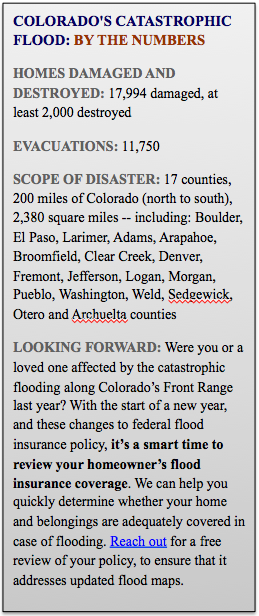
| Many Coloradans lost homes, cars, and businesses in the path of the floods that swept the state in September 2013. (Photo By Helen H. Richardson/The Denver Post) |
The overall
message to homeowners is that if you currently own a flood insurance policy or are
concerned with it as a potential risk, enjoy the additional funds in your bank
account for the time being. However, continue to be informed of your home’s
risk and changes to premiums following the final government policy.
We can help you
assess what this all means for your home (and your bank account), to make sure
your home is well protected. Call us or visit us online for an easy quote, or more
information.
John Jacquat: (303) 834-1001
Subscribe to:
Comments (Atom)