Wednesday, March 12, 2014

2014 Insurance Claims Predicted To Increase


Climate change and weather disasters on the rise
More than 5.6 million people hold flood 
insurance policies in over 21,800 communities 
across the country
Floods. Tornadoes. Hurricanes. Fire. Hail. Damages and spending on weather disasters and a changing climate have been on the rise since 1980 and are projected to increase, in part due to climate change. We Coloradans experienced the catastrophic effects that severe weather can have on our homes, business, and communities last September when we received an average year’s worth of rain in seven short days. The cleanup effort in the aftermath of the flood described as “biblical” by the National Weather Service is just the beginning of costs associated with such severe weather. 

Are you fully covered? Review your policy and make sure it protects you in case Mother Nature decides to impress us again in 2014.

Statistics show the reality that we’re seeing a change in weather patterns. Experts predict more severe weather this year than last, indicating the possibility of higher costs to individuals and communities nationwide, as weather-related claims have risen steadily over the last several years.

Global reinsurance firm, Munich Re, released a report focusing on what it says is a decades-long, increasingly severe series of such events and the costlier insured losses that have accompanied them. They found that the number of weather-related loss events in North America over the last three decades has "nearly quintupled," experiencing the largest increases in weather-related losses of any country. From tornadoes to hurricanes to wildfires, the continent is vulnerable to “every type of hazardous weather peril,” especially because there are no long mountain chains crossing its middle that might break up hot and cold air.

“When global warming combines with natural weather cycles,” the report states, “the risk of severe weather is intensified, and these factors will result in even larger loss costs from natural peril events than what we have seen so far.”
Experts predict extreme weather patterns to
increase in 2014 


The severe flooding and fires that affected many of our communities, families, and friends in Colorado in 2013 serve as a reminder as to why it’s important to make sure our homes, businesses, cars, and medical care are properly covered in case of catastrophe. We can look at what's happened and use that as a bit of a guide going forward. We should prepare for the weather risk changes that lie ahead.

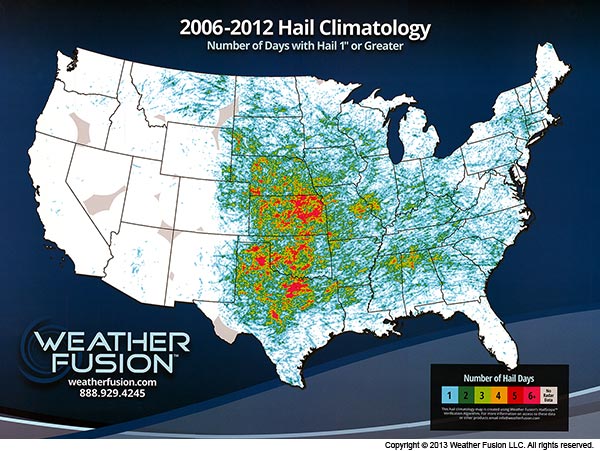
Colorado was also struck by hailstorms last summer. Almost 70,000 total claims were filed due to the disaster, and nearly half of those claims were for vehicles. The Rocky Mountain Insurance Information Association (RMIIA) estimated that more than $85 million of the damages from those storms were vehicle-related.

Hail claims are an example of optional coverage that compensates policyholders for weather-related damage. Statistics show that about 75 percent of all U.S. drivers add comprehensive coverage to a policy. A policyholder may consider skipping a comprehensive policy in order to get a cheaper quote, but in light of recent reports on increasingly severe weather across the U.S., choosing comprehensive coverage is likely a smart move.

In terms of optional coverage, comprehensive is one of the last you should give up.  It only amounts to a small portion of your auto insurance bill, but covers a lot of events, especially weather that can be unpredictable.

It’s smart to be proactive with your agent to make sure you are prepared for weather-related problems that may arise. Review catastrophes from the past year, and consider how preparedness would have helped give you peace of mind. To us at Pure Risk Solutions, that means preparing for the coming year, protecting our families, making sure the things we love most – our families, our businesses, our homes, our dreams – are well cared for and protected from weather and other things that are out of our control.

Are your home and car fully covered in case of more extreme weather this summer? For a review of your policy, call or visit us online.

John Jacquat: (303) 834-1001

Tuesday, March 11, 2014

Congress Votes To Delay Flood Insurance Hikes

More than 5.6 million people hold flood insurance
policies in over 21,800 communities across 
the country

Homeowners worried about their premiums going up can now breathe a measured sigh of relief. Both the U.S. Senate and House have voted to delay steep hikes in flood insurance rates for millions of property owners in coastal and flood-prone areas. 

Read our update to this story here.

Washington, DC – In late January, the U.S. Senate voted to delay certain measures of the 2012 Flood Insurance Reform Act, delaying significant rate hikes in federal flood insurance rates. Last week, the U.S. House passed its own version of the bill. Assuming Senate agreement, hundreds of thousands of homeowners will see a welcome cap on their premiums.

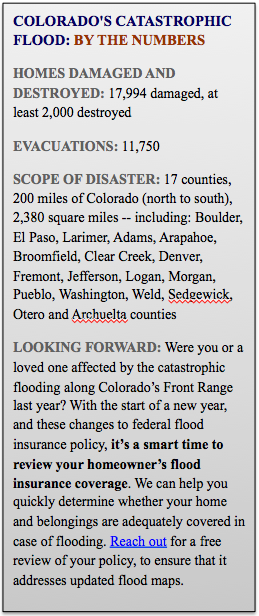
2013 Colorado Flood
The bill delays huge premium increases that are supposed to phase in next year and beyond under new and updated government flood maps, by retaining most existing flood insurance subsidies. The delays are in order to give the Federal Emergency Management Agency (FEMA) time to complete an affordability study and develop recommendations for a policy to assist working class homeowners who cannot afford their revised premiums, and to guarantee that its updated flood maps are accurate.

These changes follow an overhaul to the National Flood Insurance Program (NFIP) that Congress passed in 2012 (the Biggert-Waters Flood Insurance Reform Act (BW-12), which you can read in full at this link), to stabilize the bankrupt program. The premium increases that were set to occur resulted from changes to how the government analyzes flood risk, using modern weather patterns and environmental changes to create a more accurate reflection of “true flood risk.”

Under the 2012 changes, owners of second homes, frequently flooded properties and businesses in flood areas would gradually lose existing subsidies and pay 25 percent more yearly until they reach an actuarially sound rate.

Sensing negative immediate impacts of BW-12, the House and Senate recently passed separate reform bills to reverse some of the changes. January 30th saw the Senate’s initial version of the bill, which ultimately was a broader attempt, and ultimately set out to delay many of the intended premium increases.

The House version of the bill is slightly more conservative. Approved on March 4th, it seeks to provide retroactive funds for people who have seen large flood insurance premium increases due to the sale or purchase of a home, and limit increases to 15 to 18 percent, depending on specific flood map data.

Although it’s yet to be seen if the House version passes through the Senate and becomes federal law, recent rumblings from Washington have provided little negative feedback. Several key Senators have been on record stating that approval is likely. Although it’s not a full-on delay, relieving affected homeowners from any worry, it’s a positive for those who would be financially affected.
Many Coloradans lost homes, cars, and businesses in the
path of the floods that swept the state in September 2013.
(Photo By Helen H. Richardson/The Denver Post)


The overall message to homeowners is that if you currently own a flood insurance policy or are concerned with it as a potential risk, enjoy the additional funds in your bank account for the time being. However, continue to be informed of your home’s risk and changes to premiums following the final government policy.

We can help you assess what this all means for your home (and your bank account), to make sure your home is well protected. Call us or visit us online for an easy quote, or more information.

John Jacquat: (303) 834-1001


‘Small’ equipment loss can be a big thing


man-buying-flowersA small business may depend on equipment such as a cooler for flowers.
When you hear machinery and equipment discussed as an available insurance coverage, you may envision huge mechanical or electrical apparatus associated with large-scale operations or massive production floors.
You may conclude that your family-run flower shop or small- to medium-sized business doesn’t need this type of coverage.
Remember that insurance is about protecting your business from loss, and loss must be considered in the context of your individual situation.
  • An unexpected mechanical failure of a small refrigeration system component at an inconvenient time – for example, the day before Mother’s Day if you run a flower shop – may result in several thousand dollars of lost stock. Repair bills could be catastrophic for your business. In financially tough times, the expense may even threaten your ability to stay in business.
  • A power surge could destroy or damage the new – but just out of warranty – phone system or computer servers upon which your accounting business depends.
By comparison, a large business may be able to absorb an equipment-related loss of several hundred thousand dollars with nothing more than a few budget adjustments.
So, who has the greatest machinery and equipment loss exposure?
When you consider that mechanical breakdown is much more likely than a major fire loss, doesn’t it make sense to consider purchasing mechanical breakdown coverage for your business – no matter the size?
The good news: it’s easy and convenient. Coverage can be added through endorsement to your existing commercial policy or, if you prefer, through purchase of a separate policy.
Call us and we can help you to determine the type and amount of coverage that’s right for your situation.

John Jacquat: (303) 843-1001
Submitted by Wayne Pinney

Tuesday, March 4, 2014


Remodeling? Keep rebuilding cost in mind


home-remodeling

Make sure the insured value of your home keeps up with your home remodeling plans.

While stuck indoors this winter, did you look around and plan any home projects? Whether you do it yourself or hire a contractor, remember to update your homeowner insurance as you increase your home’s value.
The Coverage A limit on your homeowner policy is the amount of insurance you have to reconstruct your home in the event of a total loss. All costs associated with replacing or rebuilding your home are considered when developing this Coverage A limit. When you make changes that increase the value of your home, you may also need to increase the coverage limit.

Reconstruction cost is the cost to hire a contractor to replace the home as it is, in today’s marketplace, using materials and design of similar quality. Determining the reconstruction cost of your home can be a challenging and complex process. In most situations, reconstruction cost does not reflect the market value, tax assessor value or the initial construction cost of the home – even on a new home.
Construction industry statistics indicated that there was a downturn in home improvement expenditures after the recent economic recession. But now, things are starting to turn around.
Bill Shaw, GMR, GMB, CGP, a remodeler from Houston and chairman of the National Association of Home Builders Remodelers, recently commented that 2013 ended on a high note for remodelers. (See: “Remodeling Market Index Steady at Historical High.”) “We expect to keep this positive momentum going in 2014 as more homeowners will continue to take on remodels and repairs that had been postponed in the downturn.”
As you plan your next project, take an inventory of your home’s new features. Consider interior changes as well as exterior. Does the addition on your home have a different roof material than the rest of your home? Does the new deck you built include a kitchen, built-in grill or electric fireplace? Is your contractor making time this winter to install built-in bookshelves and TV cabinets? Are you finishing your attic area to create an extra bedroom? Did you upgrade your windows?
You may put lots of time into picking out countertops and appliances for your new basement kitchen, type of wood for cabinetry, color of brick to match the original portion of your home, quality of decking materials and other factors. Remember to share these important changes with your agent. Most insurance companies offer a replacement cost endorsement to ensure you will get the full reconstruction cost to rebuild your home in the event of a covered total loss, or a percentage more than the limit of insurance on your declarations page. You may also wish to explore this option with your agent.
While changes and updates you make to your home are important, consider other factors when estimating the cost to rebuild your home. Cincinnati Insurance (one of our carriers) discussed a number of them in their blog “7 factors to help nail down your home’s reconstruction cost”. Their blog “Don’t be surprised by the cost to rebuild your home” explores tools available to calculate replacement cost. And their blog“Insurance TLC for your historic home” describes building features to consider for older homes.
Discuss your homeowner coverage with us to be sure your home and the investment it represents are adequately insured in the event of a loss.
Reach out to Laura for a quick and easy policy review:                                                                   Office: (303) 834-1001 // Direct: (303) 532-4909
Email: laura@purerisksolutions.com 
Submitted by Julie Nolan

Sunday, March 2, 2014


Is your business protected from hail?

Most areas of the country experience hail storms that can cause significant damage to rooftop equipment, severely disrupting your business and costing you time, money or even customers.
A major hail storm can severely damage fins on your heating, ventilation and air conditioning equipment, rendering it inoperable. That may affect your operations or cause you to cancel functions.

You can take a few steps to help keep your business running smoothly and avoid down time by protecting the equipment that keeps your customers and employees comfortable.
Hail guards serve as a protective shield for your valuable heating, ventilation and air conditioning equipment, as well as roof vents and cooling equipment, which are highly susceptible to hail damage. Large hail can severely damage a unit, but small pellets can cause harm as well. Condenser coil damage, not noticed or addressed, affects the coil’s efficiency, increases your costs and shortens the useful life expectancy of your equipment.
Hail guards come in a variety of sizes and shapes, but most meet the needs for common equipment such as fans, air conditioners, condenser units, heaters and skylights. Many contractors offer customized options for hard-to-protect items. Look online for hail guards to find more information, resources and various types of guards.
When purchasing hail guards, consider ones that are:
  • strong enough to resist hail
  • porous enough to allow sufficient and unrestricted air flow
  • close enough to the unit to obstruct hail that strikes the roof and bounces up to the unit
  • equipped with taut mesh/fabric guards that have sufficient clearance from louvers or fins to prevent hail from deflecting into the fins
In most cases, hail guards warrant the investment when you consider the widespread frequency of hail storms and the relatively low cost of the guards compared to the down time, efficiency and shortened life or replacement of your valuable HVAC equipment. Contact your HVAC contractor or equipment manufacturer for more solutions to protect your valuable equipment and keep your business in business.
Submitted by Scott Robinson and Stephen Dale